



 I want to donate
The Road to 'The Meaning of Life'
- authise authise
- New Releases
- 16 May 2019
-
58views
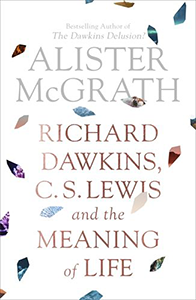
In February 2015, I was invited to give a public lecture in Edinburgh. The organizers asked me to come up with a title that would generate interest, especially in student circles. I had just published a biography of C. S. Lewis and was about to bring out a new edition of a well-received academic study of the scientific ideas of Richard Dawkins. After some thought, I decided to give a lecture comparing Lewis and Dawkins on the meaning of life.
My friend Armand Nicholi – recently retired as professor of psychiatry at Harvard Medical School – had already done something similar, giving a popular series of lectures at Harvard University comparing Lewis and Sigmund Freud on the big issues of life. So why not do the same, but this time comparing Lewis with Dawkins? I came up with the title “God, Science and Faith: Richard Dawkins versus C. S. Lewis on the Meaning of Life.” Unsurprisingly, the lecture theatre was packed out.
Word of the lecture spread, and I was asked to give the same lecture nationwide, then in the United States, Canada, and Asia. Each time, I revised the text in the light of feedback from the large audiences. Gradually, the structure of the lecture came to focus on four main topics:
1. Why meaning matters, and how ‘big pictures’ help us think about life’s greatest questions. In this section of the lecture, I compared Dawkins’ “Universal Darwinism” with Lewis’ “Mere Christianity”.
2. What reasons can we give for our beliefs? This section of the lecture examines the question of faith, proof, and evidence, and explored how Dawkins and Lewis approach this topic.
3. Belief in God. Here, I explored the radically divergent views on Dawkins and Lewis on the nature and consequences of faith. Is God a dangerous delusion, or the fulfilment of the heart’s deepest desires?
4. Can science answer our biggest questions about life – or do we need to look beyond science for answers to the question of meaning?
This short book (it’s only 20,000 words long) is an expanded version of the text of the final form of this lecture, with added references so that readers can follow through on quotations or additional sources that I mention, and a short bibliography at the end.
Richard Dawkins, C. S. Lewis and the Meaning of Life adopts a conversational tone, imagining a conversation that unfortunately never happened. It sets out both writers’ views on these important topics, with plenty of quotes to get a sense of their distinct voices and approaches. I have no interest in developing a “Dawkins is wrong – Lewis is right” approach. What I try to do is to allow both Dawkins and Lewis to be heard, and to stimulate my readers’ reflections and discussion. After setting out their views, I then reflect on where these might lead us, and what questions they might raise. At this point, I offer comments and reflection from my own perspective, or in the light of my specialist academic field of science and religion (which neither Dawkins nor Lewis seem to know much about).
Dawkins makes some points that need to be taken very seriously. In particular, he brings home the importance of the question of providing reasoned and evidenced support for our beliefs. I welcome this approach, although I wish Dawkins would apply the same set of intellectual standards to evaluate his own beliefs, not simply to criticize the beliefs of religious people. As many readers will know, one of the most damaging critiques of the so-called “New Atheism” is its rational asymmetry – in other words, using one set of criteria to judge the views of other people, and another to judge their own. Lewis also makes some good points, although there are some issues about which I raise concerns – for example, the possibility of argumentative circularity at certain points.
My concern throughout the book is not to shut down my readers’ reflections by imposing my own views, but to open up discussion by presenting two very different and very interesting conversation partners, and leaving my readers to work out where they take these ideas. In effect, I show my readers what I have found interesting in both these writers, in the hope that others will find them interesting as well. Enjoy!
Alister McGrath is Andreas Idreos Professor of Science and Religion at Oxford University. His recent books include C. S. Lewis – A Life (Hodder, 2013), and Dawkins’ God: From The Selfish Gene to The God Delusion (Wiley, 2015). He is also the author of the international bestseller The Dawkins Delusion? Atheist Fundamentalism and the Denial of the Divine (SPCK, 2007).
Related Posts
Categories
Recent Posts
4
5
Our Royal Patron in Congress
29 Apr 2026
Support SPCK with your donation
Either donate with a one-off donation or subscribe monthly.
Choose a type of donation
I want to donate
 I want to donate