




 I want to donate
Mindfulness, Spirituality & Mental Health Awareness Week
- authise authise
- General
- 13 May 2019
-
52views

Abraham Maslow’s (American psychologist, 1908-1970) theory of the hierarchy of human needs published in 1943 has, not surprisingly, had its critics over the ensuing years as the still relatively young discipline of psychology has evolved with its twists and turns of the last century. But it is still the most famous and most quoted basis as a starting point for understanding how humans can function at their best.
He suggested that there are 5 layers of need (or motivation) which must be taken into account and that, to some extent, the ‘higher levels’ (which some might link with spirituality) cannot be met if the ‘lower levels’ (physical and psychological) have been neglected. His 5 levels were:
1. Physiological needs
2. Safety needs
3. Relational needs
4. Esteem needs
5. Self-actualisation (which he later changed to ‘transcendence’)
In this really important Mental Health Awareness Week, recalling Maslow’s work might remind us that it is inadequate for Christians to focus only on the spiritual side of their lives without making any attempt to understand their psychological needs – or indeed their physical needs (though perhaps we are a bit better at this).
Mental health, we now know, is a sliding scale and not some kind of disease you can catch. If the circumstances of your life (both inner and outer) come together in a particular way even the most resilient of us can start to feel the effects and, if not checked, can slide down the slippery slope towards stress, depression, anxiety and the like.
And the other side of this coin is for us to understand very clearly that people who are already mentally unwell need support which relates to their psychological distress probably before or at least alongside their need for spiritual support.
When I discovered the practice of mindfulness in a secular, psychological context, it was a revelation to me. I had been a practising Christian for nearly 35 years and a Vicar for 15 but no one had, up to that point, shown me an effective way of managing stress in my life. I knew lots of theology, had practised contemplative forms of Christian prayer and had some training in pastoral care but still mindfulness as it was being shown to me came as utterly new – and transformative.
In effect it is really just simple psychology based on on-going research. But the key was that it worked. It made a difference in a way that none of my previous knowledge and practice of religion had done before.
So really my plea and my longing is this – let us who are Christian and so aspire to help both ourselves and others to come into our full humanity pay much more attention to our psychological needs and our psychological healing as a basis for then being able to explore our spiritual needs. And let us stop wondering why some of our very best efforts to care for people spiritually just seem to us to fall on deaf ears. Perhaps the ears are not deaf at all but are simply waiting for the right words. And perhaps the right words at a certain point are those which are imbued with psychological rather than spiritual insight.
And added to this, let our teaching of spiritual practice (whatever kind of prayer we lean towards) at least take full account of what we know of psychology. We may not want to stop (as Maslow didn’t) at psychological wholeness but we at least need to cover this base.
For me, mindfulness has been such a great platform for my own spirituality because I know it takes account of my psychological needs along the way. I know it has helped with managing stress and anxiety, and has helped me manage work and relationships so much more healthily. So when I start to practice meditation based on mindfulness techniques, I know I am safe, and so know I can explore the more challenging spiritual territory without worrying that I may be impairing my mental health.
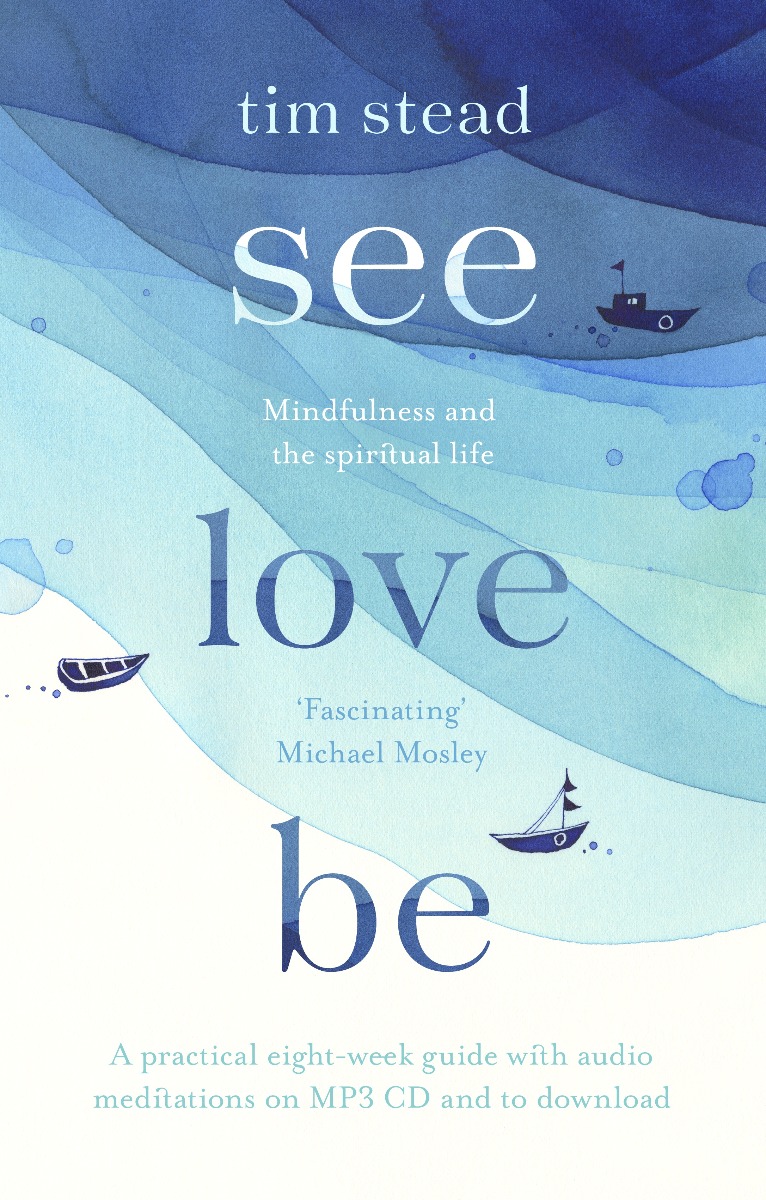
Many people have found Mark Williams’ and Danny Penman’s book ‘Mindfulness – a practical guide to finding peace in a frantic world’ to be a helpful starting place. I have used this material as the basis for my own book ‘See Love Be – mindfulness and the spiritual life’ which is a ‘self-help’ book with accompanying CD aiming gently to orientate mindfulness practices towards the spiritual goals of awareness, compassion and ease of being. I have tried to find a language of spirituality which can speak to people of different spiritual traditions including those who call themselves ‘Spiritual but not religious’ but it can still relate to the Christian faith and our own aspirations as followers of Jesus.
Mental Health Awareness Week is really simply a call for compassion which is a very deep call to the Christian. But compassion, necessarily, must lead to action. So it would be good to let this week inspire us to grow in psychological awareness both for our own sake and for the sake of those who suffer so horribly at the sharp end of mental health.
Related Posts
Categories
Recent Posts
4
5
Our Royal Patron in Congress
29 Apr 2026
Support SPCK with your donation
Either donate with a one-off donation or subscribe monthly.
Choose a type of donation
I want to donate
 I want to donate