



 I want to donate
The Promise and Peril of AI: An interview with Stephen N. Williams
- Laura Barry
- General
- 25 Apr 2023
-
124views

With Artificial Intelligence dominating the news, we spoke with Stephen N. Williams, renowned co-editor of The Robot Will See You Now and Honorary Professor of Theology at Queen’s University, Belfast, to delve into the popular and fascinating topic of AI. Williams sheds light on the potential benefits of AI, such as its capacity to handle complex computations and collate vast amounts of research. However, he also highlights the ethical and existential concerns associated with AI, including the possibility of losing control over its operations and ensuring that its development is ethically responsible.
Our interview also explores whether AI is redefining what it means to be human and the ongoing debate on whether AI research is moving too fast. Williams also reflects on the importance of regulating AI and the challenges and uncertainties associated with it.
With AI's significant impact on society, it's essential to understand these issues, and The Robot Will See You Now offers an opportunity to explore this engaging topic further.
Additionally, the paperback and ebook version are currently available at a 20% discount for the next two weeks, making it an excellent opportunity for anyone interested in seeking to understand AI's implications and the challenges AI poses.
Use the coupon code ROBOT20 at the check out until May 9th to receive 20% OFF.
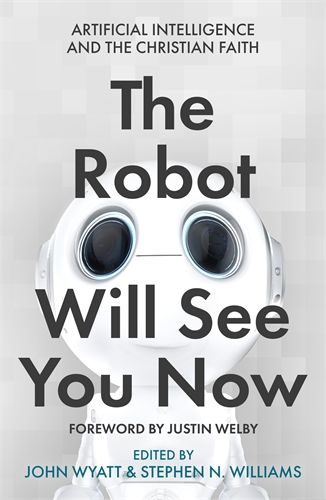 |
The Robot Will See You NowEdited by John Wyatt and Stephen N. Williams The last decade has seen dramatic advances in artificial intelligence and robotics technology, BUY HERE |
Artificial Intelligence has been threatening to shake up our lives for a while, but something about this moment in time seems to be different. Do you believe that the recent advancements in Artificial Intelligence, specifically with CHAT GPT and other technologies, indicate a tipping point in the business world, or is it merely exaggerated by media hype?
Those of us who lack first-hand knowledge of the business world must be extra cautious in our assessments, as Covid-19 has revealed how easily business projections can be thrown off balance. Whether or not we have reached a tipping point in AI depends partly on whether there will be a pause in AI research, which some prominent figures in the field are advocating. At the moment, this seems unlikely to happen. Nevertheless, there’s enough anecdotal evidence around the impact of ChatGPT to suggest that it can’t be simply dismissed as media hype.
What are the benefits of Artificial Intelligence (AI)?
We often need to distinguish between surface benefits and underlying benefits, but with AI, the benefits may all be on the surface. They are there for everyone to see: speed in handling complex calculations, and the ability to synthesise the results of vast amounts of research are amongst the most obvious. However, what should we say when AI discovers molecular properties that humans have not only never dreamed of, but might be constitutionally incapable of conceiving or understanding? That happened dramatically in MIT two or three years ago. If AI can operate in a realm beyond what is humanly accessible, it is difficult to judge confidently at the moment whether or not this is an underlying benefit. The humanly unknowable might not be a threat, but what about non-human access to the unknowable by humanly created AI?
What are the potential dangers and ethical considerations associated with Artificial Intelligence (AI)?
Technologies can be devised without malicious intent, but their motivations still need to be scrutinized. They can be created to benefit the privileged minority, even though universal well-being is the stated goal. Several risks and ethical concerns can be identified, and people at the forefront of AI research and development are themselves willing to describe these. Perhaps the main risk and concern, which is often mentioned, arises from our ignorance of the scope of AI. Is it realistically possible that we could lose control of its operations? Enough voices are sounding that warning for us to take it seriously.
Is there a way we can ensure the ethical integrity of AI technologies?
It’s difficult to see how we can ensure that AI technologies are ethically sound. A document on human augmentation, produced jointly by the Bundeswehr Office for Defence Planning in Germany and the Development, Concepts, and Doctrine Centre in the UK, gives us at least two reasons to say so. Firstly, it states that if other countries develop technologies which are ethically unsound, we shall reluctantly be forced to do the same for the sake of self-protection. Secondly, it raises questions about the ‘moral enhancement’ of combatants. Does this include creating guilt-free, emotionally detached soldiers? If so, we would be producing the opposite of normal moral health, where the capacity for proper (not false) guilt is an important human asset. AI is implicated in human augmentation. Of course, that’s a restricted area of AI. It raises a broader question: when we move beyond generalizations about protecting human freedoms and avoiding harming others, the question is: who determines what is ethically sound?
How might artificial intelligence impact the definition of humanity and redefine what it means to be human?
Although AI contributes to the redefinition of what it is to be human, it is also the product of changing definitions. In the early days of AI, in the 1950s, there was emphasis not only on reason as central to humanity but also on calculation as central to reason. There were echoes here of a much earlier belief that humans are fundamentally machines. AI has progressed significantly since the 1950s, but that belief is still widespread, and much – definitely not all – of the thinking about AI reflects it. More broadly, for a long time, there has been pressure from various quarters on the idea that there is such a thing as fixed human nature. AI surely increases that pressure.
Is AI research moving too fast? Should it be halted as suggested in the open letter calling for a Pause on Giant AI Experiments, given the potential risks associated with the development of AI systems with human-competitive intelligence?
AI embraces many things. It can be treated as a sub-field or sub-discipline of computer science, whose research objectives have nothing to do directly with, for example, some quest for superhuman, maybe conscious, superintelligence. But the outcome of research is not in the hands of researchers, a lesson gravely learned with the splitting of the atom. Although some believe that those who call for a pause are largely motivated by business envy of ChatGPT, it would be a mistake to assume that there is nothing more to it. There is enough ethical substance in the call to pause for us to heed and to support it.
Can you discuss the importance and feasibility of AI regulation, and whether the lack of regulation in authoritarian regimes such as China would give them an upper hand over Europe and America, for example, if AI was regulated there?
We are in largely unknown territory, and, in her book on The Age of Surveillance Capitalism, Shoshana Zuboff graphically describes the lawlessness surrounding the territory occupied by high-tech companies. If many businesses are ahead of the law, high-tech businesses are ahead of other businesses. Regarding China, the basic ethical question here is similar to what has long been asked in relation to arms races. Even in relation to nuclear weapons, we do not know the final outcome of the regulation we have at this moment. AI regulation is undoubtedly important, but it’s hard to see how it could be achieved at present on a scale and in a way that is effective in the most important areas. We are revisiting a perennial problem: from a Christian point of view, how far should we be willing to expose ourselves to huge risks to stick to principles? Should we say: ‘Then let them have the upper hand’?
How does AI impact employment and what are the potential social consequences?
The jury seems to be out on this. I think we must consider not only the question of unemployment, but also the effects of AI on those who are currently or will be employed in the future. What kind of training will medical practitioners need if diagnostic skills are increasingly the province of AI? Into what relationship will they enter with patients? If robots participate in caring for the elderly (as is already happening in Japan), how will this affect the relationship between regular care workers and those they serve? As we have yet to see these things unfold on a large scale, the range of social consequences is hard to predict with complete certainty.
Will AI exacerbate or help income inequality? Is AI development reinforcing the power of the Titans (big businesses – cloud providers, big tech, for example) or are we seeing another opportunity where it will unleash new creativity, new startups, for example? What sense are you getting?
It’s impossible to detach this question from the wider question of what Western and Northern hemisphere technological advances have done to inequality. There will always be new opportunities for some people. But it looks as though our technologies have increased, not decreased, inequalities both within nations and on the global level, though generalization is dangerous and unwarranted unless it is backed up by minute study of a range of different situations and scenarios. This all applies to AI.
What are the privacy concerns of AI? The Robot Will See You Now explores this in detail.
Privacy concerns arise on at least two levels. There is the level of national governance: if the balance of public security and individual freedoms is always a theoretically delicate matter, does not AI affect the balance by increasing the threat to legitimate privacy? There is also the level of individual use of, for example, web resources: have we consented to the amassing of data on us which the high-tech companies have harvested through the medium of AI? I confess that I find the outlook grim as regards privacy, though we users cannot escape responsibility when we risk our privacy for the sake of our convenience.
With the rise of AI, do we need new regulatory laws, such as IP/copyright laws?
New technologies frequently need new regulatory laws, and AI is the last possible exception to this! To all appearances, what those laws should be is a complex matter, and the possibility of their enforcement will depend on their nature.
Interested in learning more about artificial intelligence and robotics? Whatever your level of technical knowledge, The Robot Will See You Now, will give you a thorough understanding of AI and equip you to respond to the challenges it poses with confidence and faith. Don't forget to use the coupon code ROBOT20 to receive 20% OFF now until May 9th.
Related Posts
Categories
Recent Posts
4
5
Our Royal Patron in Congress
29 Apr 2026
Support SPCK with your donation
Either donate with a one-off donation or subscribe monthly.
Choose a type of donation
I want to donate
 I want to donate