




 I want to donate
Spanning the Decades
- authise authise
- General
- 15 Apr 2019
-
40views

The story in The Restless Wave takes place over a century. A hundred and one years if we’re being really picky. The earliest chapter takes place in 1915 and the story concludes in 2016. But the story isn’t told in a linear way; I don’t plod through the years in strict chronological order. Don’t get me wrong; I wanted to give a sense of the arc of time, as world events and social change affected my characters. But I did that by dipping in and out of the decades. I’ll be blogging about that over the next few weeks.
So how did this story come about? Well, I’m very interested in family dynamics, and in particular, the values and experiences that get passed from generation to generation. Our unique family myths. Some of these are articulated and acknowledged, and others not. They’re just there. I wanted to show how a family narrative evolves over time.
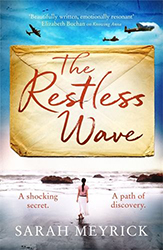 One of the three central characters in Theve made a cameo appearance in my first novel, Knowing Anna. Edward (as yet unnamed) merited a mere three paragraphs in that book: he was a man who came back from the Second World War changed for ever. He wasn’t especially likeable – in fact, my mother shuddered when I told her I was writing his story. But I wanted to know how and why he’d become the person he turned into. That meant delving back into time.
I knew that the War had changed him. Like many men of his generation, when he came home, he didn’t want to talk about his experience. Of course, these were the days before Post-Traumatic Stress Disorder was recognised. And when everybody you knew had been affected by the War, I can imagine that there was a great reluctance to examine your own experience too closely. By the standards of the time, that would have been judged self-indulgent. You’d survived when countless others hadn’t: wasn’t that enough? It appears that the vast majority of people simply knuckled down and got on with rebuilding their lives.
To understand Edward, though, I had to go back further. What about his upbringing, his experience of the world before he went away to the War? What were the values that had formed him? Thinking about that led me to India during the Raj – a period that has long fascinated me – and so it went on. That got me thinking about the different decades of the twentieth century.
What was it like, growing up as Edward did in the 1910s? After all, he could have been my grandfather. What were the circumstances when he went to school, university and then fell in love? How was that different from the experience of his own children, born in the 1930s and 1940s? It’s well known that many of the generation that came of age after the War wanted to shrug off their parents’ values. Of Edward’s six children, one in particular, Hope, does this in spectacular style. And her world was different again: the bleak post-War years of austerity; the sudden wild freedoms of the 1960s; the hippie years of the 1970s.
As so often happens, in my story, the pendulum swings back again. Hope’s daughter Nell turns her back on her mother’s values, for reasons that make complete sense to her. And that’s one of the fascinating conundrums. How are we formed? Is nature or nurture more important? How do you factor in changes taking place in wider society, outside the family? The influence of friends and teachers and partners? The particular events and upheavals of the decade?
Some of this, I have lived through myself. Nell is younger than me, but older than my daughter. Hope is more or less the age of my parents. They were children during the War, and even twenty years later, I grew up with a sense of its shadow. They are the generation who remember rationing and abhor waste. To whom recycling and reusing and composting is old news. To this day, my mother cannot leave a scrap of butter on her plate because she remembers how precious it was in the War.
The great luxury of writing about a long period of time is that one has the chance to sweep through history, cherry-picking the sort of details that seem to matter for the evolving narrative. It meant doing plenty of homework, delving into the last hundred years.
But while I’ve striven for accuracy, that’s not to suggest I think I’m writing history, or trying to be definitive; the novel is simply a story, set over a particular period of time. Being a writer is all about poking into unknown corners, wandering into lives that are not your own. Imagining paths not taken, lives not lived. And then inviting the reader to travel with you.
1910s
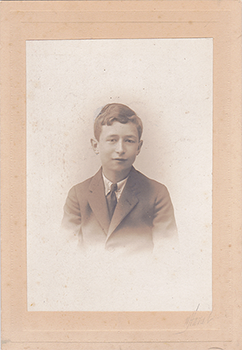
I’m very fond of this photograph. I had it pinned to the pinboard above my desk when I was writing The Restless Wave. It’s my paternal grandfather Bobby. In fact, ‘Bobby’ wasn’t his real name at all, although this is the name he always went by.
The story behind this is splendidly Victorian. My great-grandparents decided to name him after the family friend who was to be his godfather, in the hope that the said godfather would do well by his godson. It was only in the carriage on the way to the christening that the would-be godfather revealed that his nickname Bobby was not a diminutive of Robert, as the hapless parents had imagined, but a sort of nickname for, well, Brainard. By now it was too late to backtrack, so of course my great-grandparents took a deep breath and said they would proceed as planned. So my poor grandfather was named Brainard, along with Edgar and Thomas. No surprise he stuck to Bobby.
Bobby was born in 1901, so he’s a little older than my character Edward, who arrived in 1908. But they are more or less contemporaries, and the picture helped me think about Edward as I wrote his story.
I don’t know whether Bobby’s godfather ever came up with the goods, or remembered him in his will. Family history doesn’t relate. But as far as I know, his family circumstances were much happier than Edward’s. Nonetheless, I think there’s an air of vulnerability in his photograph.
Also in my possession is the Latin dictionary Bobby took to boarding school, with his name embossed on the cover in gold. I think of him setting off to school with his dictionary, a few days after the outbreak of the First World War. The War that killed his brother Aylmer, and no doubt a number of boys who’d been a few years ahead of Bobby at school. I wonder how it felt to go to university alongside survivors of the trenches, knowing that you’d missed the War by a whisker.
Edward was far too young to fight in the First World War, of course. But it still helped shape the man he became. I know books were precious to him. I like to think that a Latin dictionary engraved with his name, like Bobby’s, travelled with him, and perhaps ended up on the bookshelves of one of his granddaughters too.
See you on Friday for our next decade! Pre-order your copy of The Restless Wave!
Related Posts
Categories
Recent Posts
4
5
Our Royal Patron in Congress
29 Apr 2026
Support SPCK with your donation
Either donate with a one-off donation or subscribe monthly.
Choose a type of donation
I want to donate
 I want to donate