





 I want to donate
Spanning the Decades: 1940s
- authise authise
- New Releases
- 26 Apr 2019
-
59views
The research behind The Restless Wave
Every novel requires a lot of research. In the case of this book, the action takes place over the space of a century. So that required really quite a lot of homework.
Some of this was simply historical. Much of the action of the book takes place around D-Day and the Normandy Landings. An enormous amount has been written about the Second World War, of course, so that is relatively straightforward. What’s much more complex is pulling together all the little details that make the narrative feel authentic. What slang was used in 1944? What was fashionable womenswear in 1959? What was going on in the field of education in 2016?
Then there’s the question of how much detail you need to go into. As a novelist you are trying to tell a story, not write a history book. But the more you probe, the more you realise you don’t know. It’s very easy to get bogged down to the point where you feel utterly swamped. But it was a lot of fun, too. I love learning about new things. And I made some rather wonderfully serendipitous discoveries along the way.
In the end, I accumulated much more research than I actually used, but I’m sure that’s necessary. I had to remind myself that I was writing a novel, not a historical guide. Nonetheless I wanted to know enough to avoid making too many obvious howlers. Fingers crossed…
1940s
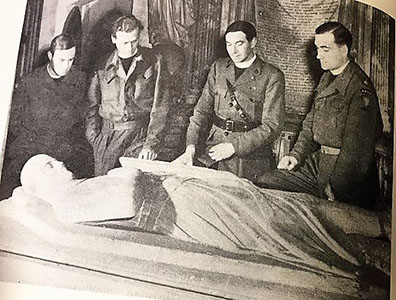 Edward, one of my three main characters, was a chaplain in the Second World War, and like many other padres, accompanied the troops into Normandy on D-Day. I knew a fair amount about the Battle of Normandy thanks to visiting the museums and memorials that pepper the Normandy coastline over many years, but I didn’t know anything about chaplains. I spent a fascinating morning at the Museum of Army Chaplaincy in Hampshire, with its curator, David Blake. (He was so helpful he gets a name check in the story itself, as well as in the acknowledgements.)
As well as answering any number of questions, both on the day and then afterwards by email, David made some very helpful introductions to others who were researching the story of army chaplains in the Second World War. One of these was a woman called Jenni Crane who bought a suitcase in a junkshop – and then discovered it had belonged to one Padre George Parry, who was killed on D-day. And she put me in touch with Frank Treble, whose father Harry had left an unpublished memoir about his D-day experience. All fascinating.
Anyway, in the course of our conversation, David mentioned that a number of padres were sent for highly secret battle training in Northamptonshire just before D-Day. On asking for the location, I discovered to my surprise that it was a little village called Church Stowe, barely six miles up the road from where I lived at the time.
It was tough training, too, using live ammunition. Believe it or not, some of it is still lying in the surrounding fields, all these years later. While I was talking to David I remembered an incident that took place only a few weeks before our conversation. My husband and I were driving down the A5, past the turn-off to Church Stowe, when were stopped by police.They told us that they had closed the road while an Army bomb disposal unit removed a stray piece of unexploded ordinance. It seemed that the more deeply I delved, the more serendipitous my desire to tell this story began to feel.
This picture comes from inside the church, sadly usually locked these days, where the men have gathered around the tomb of a knight. For inspiration, presumably.
Related Posts
Categories
Recent Posts
4
5
Our Royal Patron in Congress
29 Apr 2026
Support SPCK with your donation
Either donate with a one-off donation or subscribe monthly.
Choose a type of donation
I want to donate
 I want to donate