





 I want to donate
Prayer Experiment Activity
- authise authise
- Children's Books
- 5 Apr 2019
-
85views
Prayer can seem either boring, or something that you have to be a spiritual expert to do. And this means that it is something children are often excluded from. Either they are thought to be too young to sit in silence, so we give them something to occupy them while the adults pray - or they are thought of as too ignorant to be allowed to lead their own prayer lives, and so we occupy ourselves in teaching them rather than trusting in the spiritual experiences that they could have on their own with God. We teach them about Christianity, rather than letting them experience it.
And yet in the Christian tradition there are many different forms of prayer – with many similarities to what schools are rediscovering about how children learn best through doing. People have prayed through music, through craft, and by using their imagination and their bodies, as well as in silence and through sitting still. We have a rich history from around the world of Christian prayer in all sorts of different styles, and yet for many of us our experience of prayer is very limited to what looks like ‘proper’ prayer.
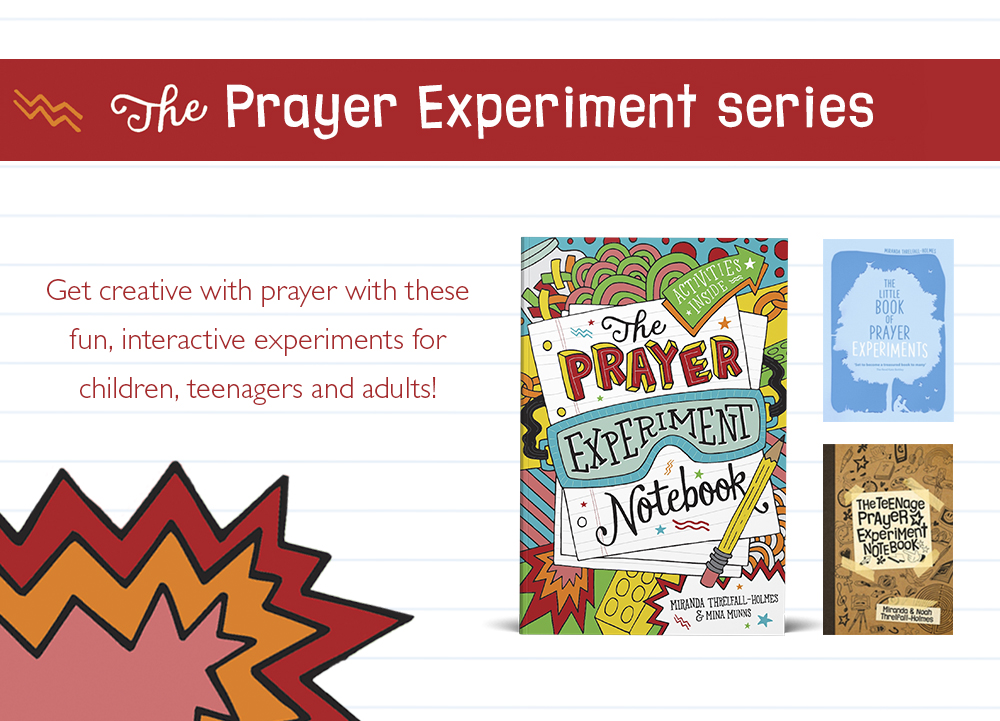
And so a few years ago, my teenage son Noah and I sat down and decided to try out all sorts of different ways of praying. I’d describe a way of praying, and he would try it out. The books ‘The Teenage Prayer Experiment Notebook’ (for 12-17s) and ‘The Prayer Experiment Notebook’ (for 8-12s) are the results.
They aren’t so much books about prayer by experts, as books encouraging children and young people to be the experts in their own prayer lives, to try things out, make their experimental notes, and try again in a slightly different way. There’s also an encouragement to compare their notes and experiences with those of others, either the examples given in the books or by comparing notes with a Sunday School or Youth Group all doing the same experiments together.
Here’s one of the most popular experiments to try for yourself:
Lego Bible Modelling (From the Prayer Experiment Notebook)
In the Bible itself, spending time reading the Bible is described as being like a tree, with our roots going deep into the soil, drinking up the life giving water. If we spend time 'drinking in' the Bible we become deeply rooted, fed, stable and fruitful.
Spending time with the Bible doesn't have to mean always agreeing with it. Reading the Bible prayerfully is not about deciding whether it is true or not, or doing what it says. It is simply about spending time with the stories there, and seeing what they say to us about God, about the world, and about ourselves.
One way of praying with a Bible story is to read it and then imagine yourself there.
What does it feel like - Hot? Cold? Windy? Is there sand between your toes, or are you on rough grass?
What does it smell like - Animals? Flowers? Cooking smells?
What does it sound like - a busy crowd? Shouting? Silence? Birdsong? Water lapping at the seashore?
What does it look like - what can you see?
Then you imagine yourself in the scene.
Who is there? What about you yourself - what part you are playing?
Are you a bystander, or one of the characters in the scene?
And then you imagine Jesus turning to you.
What does he say?
This is a bit like that, but less 'sit still and think' and more 'get out the Lego and build'. You are going to recreate, in Lego, a story from the Bible. The challenge isn't just to work out what the scene would have looked like. You'll also need to think about what the characters in the story are thinking or feeling at different points in the story. Try to choose Lego figures with appropriate facial expressions, and pose them in ways that expresses what you think they are feeling.
- The first thing you'll need to do is choose a Bible story. There are some suggested here, but you can choose something else if you prefer, maybe one of the readings you have heard in church or assembly recently. Or you could ask a parent or youth leader or minister to suggest one for you. If you have a group of friends to do this with, it can be fun to all try the same story and see how different your models are.
- You can decide whether you want to model the whole story, or just one scene from it. If you want to model the whole thing, you could try taking a series of photographs of the different scenes as you go, and create a sort of photo cartoon strip. You could even take lots of photos and try putting them into some stop-motion animation software, to make a short animation of the story. If you do this, why not offer it to school or your local church for them to show in assembly or a service, instead of just reading the story?
When you have finished, you could show your model, or photographs, to friends and family. If you do this in a group or with friends, why not try modelling the same story and then at the end compare how different your version is from your friends and discuss why?
Related Posts
Categories
Recent Posts
1
UK Launch of Called to Care by Jo Knight
28 May 2026
5
Support SPCK with your donation
Either donate with a one-off donation or subscribe monthly.
Choose a type of donation
I want to donate
 I want to donate