



 I want to donate
Does Richard Dawkins even agree with himself?
- Emma Collins
- New Releases
- 20 Nov 2019
-
72views

Does Richard Dawkins even agree with himself? Among other pieces of evidence I have in mind is an article he wrote for The Guardian in 2002 extolling a spirit of free enquiry in the classroom.Despite a welcome side-swipe against the teaching of creationism at a school in Gateshead, Dawkins’s focus was not on religion. Volleys were instead directed at the rigid, box-ticking culture beloved of some educationalists.
The heart of the piece was a tribute to F. W. Sanderson, headmaster of Dawkins’s school, Oundle, from 1892 to 1922. Sanderson’s faith was yoked to a passion for science: the subject became part of the core curriculum on his watch. Dawkins judged that Sanderson’s sermons in the school chapel could reach ‘Churchillian heights’, quoting one such address celebrating great pioneers:
Mighty men of science and mighty deeds. A Newton who binds the universe together in uniform law; Lagrange, Laplace, Leibniz with their wondrous mathematical harmonies; Coulomb measuring out electricty... Faraday, Ohm, Ampère, Joule, Maxwell, Hertz, Röntgen; and in another branch of science, Cavendish, Davy, Dalton, Dewar; and in another, Darwin, Mendel, Pasteur, Lister, Sir Ronald Ross. All these and many others, and some whose names have no memorial, form a great host of heroes, an army of soldiers – fit companions of those of whom the poets have sung...
As well as taking the complementarity of science and religion for granted, Sanderson nursed a healthy contempt for jingoism. Another of his addresses juxtaposed the Sermon on the Mount with the unthinking patriotism attached to Empire Day (‘Blessed are they that mourn, for they shall be comforted. Rule, Britannia! Blessed are the meek, for they shall inherit the earth. Rule, Britannia!’). He also did away with what he saw as undue institutional restrictions, even asking that laboratories be left open at all times to let pupils pursue their own projects. He died suddenly in 1922 having just given a lecture, chaired by H. G. Wells, to science teachers gathered at University College London. Speaking in the same place and to a similar audience 80 years later (this time presided over by an ‘enlightened clergyman’), Dawkins reported hearing of deep worries among today’s teachers about a failure to teach evolution in British schools. The blame for this lay not with faith groups, but with the A level syllabus itself. ‘Evolution gets only a tiny mention, and then only at the end of the A level course. This is preposterous for, as one of the teachers said to me, quoting the great biologist Theodosius Dobzhansky (a devout Christian, like Sanderson), “Nothing in biology makes sense except in the light of evolution.”’
Though of a different generation from Dawkins, I sat in the same lab as him decades later and was inspired by the same biology master, Ioan Thomas – also spoken of with great respect and affection in The Guardian piece cited and, as it happens, also a person of strong Christian conviction. (When I left the school it was to spend a while teaching in the state sector, and finding proof of the adage that good and less good teaching styles cut right across all sorts of other divides.)
Anecdotes like these could be greatly multiplied and serve several purposes. Again and again, angry atheists link religion in general and Christianity in particular not just to multiple falsehoods but to mind control. Two logically separate points are being conflated. First stand questions about the credibility of this or that article of faith. Then there is the issue of whether young people inducted into a particular tradition – Christian, humanist, Buddhist, you name it – are allowed to make up their own minds about it and move on if they wish.
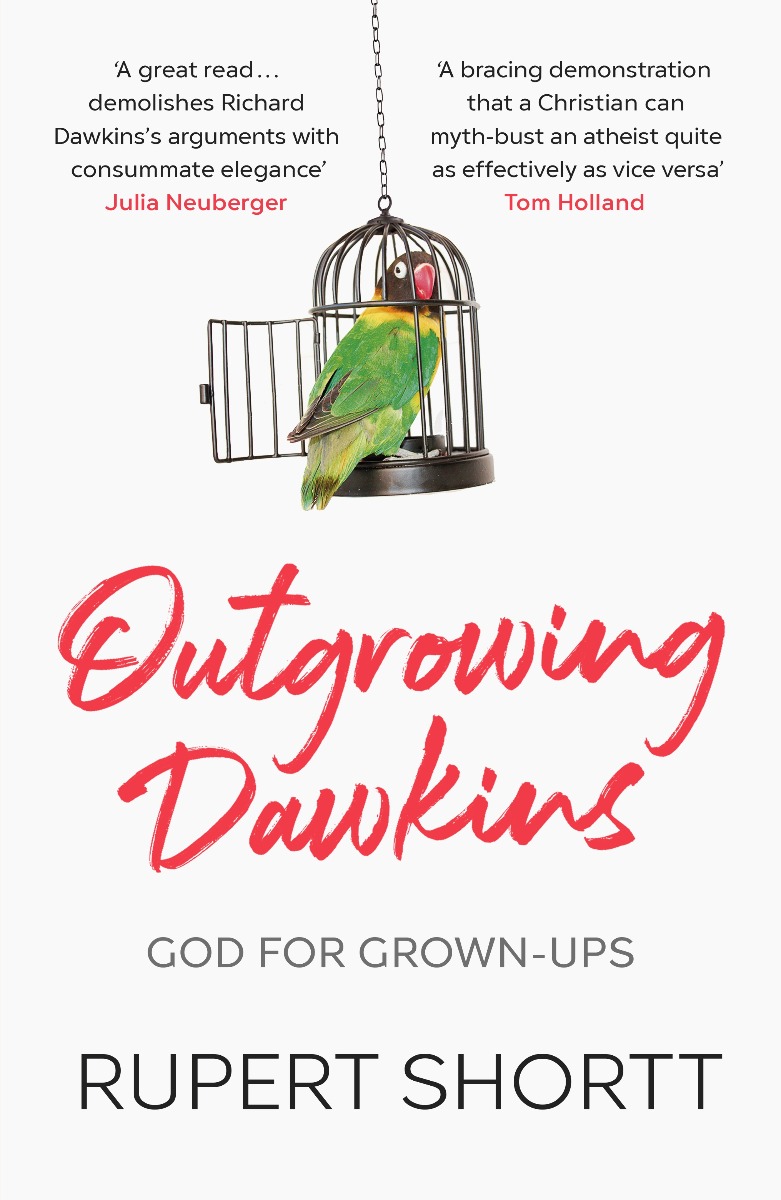 In this incisive rebuttal, Rupert Shortt exposes the main flaws in Dawkins’s arguments – his weakness for crude caricatures, selective way with evidence, ignorance of philosophy and history as well as theology, and even his questionable interpretations of science.
Related Posts
Categories
Recent Posts
1

Thoughtful Christian Books for Father’s Day
11 Jun 2026
5
Support SPCK with your donation
Either donate with a one-off donation or subscribe monthly.
Choose a type of donation
I want to donate
 I want to donate