


 I want to donate
Converting to Orthodoxy
- authise authise
- New Releases
- 1 Jul 2019
-
241views
When did you decide to convert? How long have you been Orthodox?
‘How long have you been Orthodox?’ This question from my Orthodox friends greeted my announcement that I was writing this book. ‘Since March,’ I replied, ‘March 2018.’ The usual response in this often repeated conversation was, ‘So, how are you qualified to write this book?’ I tried a variety of answers, explaining that my interest in Orthodoxy began with the building of the Serbian church in Birmingham in 1968, that my copy of Ware’s The Orthodox Church carries my name and the date 7 September 1970, that I once heard Anthony Bloom speak, that I studied patristics as an undergraduate. Nothing could really disguise the fact that I barely acknowledged the existence of the Orthodox Church be- tween my Anglican ordination as a deacon in 1979 and the London diocesan visit to St Petersburg in 2003. It would be another twelve years before I came to share the worshipping life of an Orthodox parish during my six-month sabbatical in Helsinki in 2015. I found my way to a simpler answer. This book, the fruit of my becoming Orthodox, should be treated as a travel book, a somewhat idiosyncratic guide to a country that the writer likes so much that he has chosen to move there.
What is Orthodoxy?
To understand Orthodoxy, it is necessary to think and act as the Orthodox do, suspending the Western analytical sense and allowing free rein to the synthetic tendency, to that which detects a unity and perceives, however dimly, the interaction of the parts. The Orthodox Church is indelibly marked by the One who is its origin and source. As we move constantly between Unity and Trinity in God, so we must move between the parts and the whole in the Church, the whole being infinitely more than the sum of the parts. To perceive this, to be grasped by it, to be unable to free oneself from it, this what it is to be Orthodox.
Why did you convert?
It is from this double position – as a new convert to Orthodoxy and as a theologically qualified participant in IOTA – that I presume to write this book. I did not leave the Church of England because of some profound disagreement and I did not, and was never asked to, renounce and repudiate my past ministry; rather, I willingly repented of past heresies and errors (which, fortunately, I did not have to list) and embraced Orthodox faith and practice. This book – Being Orthodox rather than the more tentative Becoming Orthodox that I had proposed at first – comes out of that experience. It is a convert’s view. Cradle Orthodox may indeed see it differently and still find me presumptuous. I was principally drawn to Orthodoxy by its unequivocal profession of faith in God the Holy Trinity. Father Nikolai Voskoboinikov was kind enough to say publicly, on the last Sunday of my sabbatical, that I love God like an Orthodox. I recognized that he had perceived in me something that I had not yet seen, nor did I immediately grasp the consequence – that if you love God in that way, it is best to be Orthodox.
Why should we read the book? What shall we expect in the book?
A guidebook is necessarily limited in its scope. This one reflects my own journey to Orthodoxy and those features of the Orthodox Church that have become particularly significant for me. Some guidebooks claim to show you what others only tell you. It is not possible to ‘show’ Orthodoxy in a book, nor can it be grasped in any meaningful way in a few visits to its outposts.
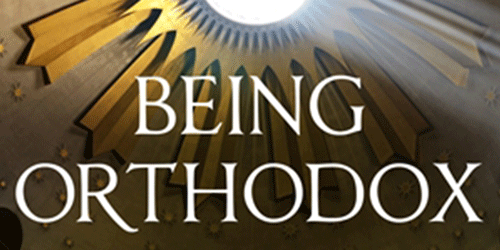
This blog post contains adapted extracts from Being Orthodox: Faith and Practice in Eastern Orthodoxy
Related Posts
Categories
Recent Posts
4
5
Our Royal Patron in Congress
29 Apr 2026
Support SPCK with your donation
Either donate with a one-off donation or subscribe monthly.
Choose a type of donation
I want to donate
 I want to donate