

Close
It appears you don't have the ability to view PDFs in this browser.
Click here to download the sample directly.
It appears you don't have the ability to view PDFs in this browser.
Click here to download the sample directly.
| Publication Date: 21 Jan 2010 |
|---|
| Publisher: SPCK Publishing |
| Page Count: 112 |
| Author: Robert Van der Weyer |
| ISBN-13: 9780281062102, 9780281065127 |
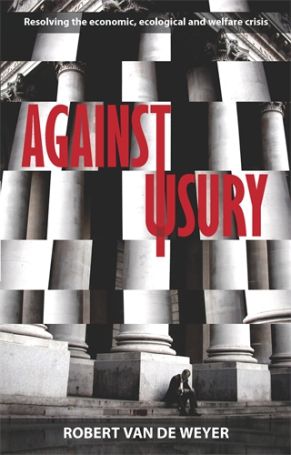
Against Usury
Resolving The Economic And Ecological Crisis
In stock
ISBN-13
9780281062102-grouped
From £8.99
Robert Van de Weyer argues that humanity faces a trio of chronic crises - economic, ecological, and in the provision of welfare services - whose causes are various connected forms of usury. Following the religious teaching of Christianity and Islam, which have traditionally condemned usury as the fundamental source of social injustice, he defines usury as the unequal allocation of risk. He offers practical proposals as to how usury may be reduced or eliminated, showing that the solution to each crisis depends on solving the others.
Robert Van de Weyer was for many years a university lecturer in economics, specializing in economic philosophy, environmental economics (on which he has written two previous books) and monetary economics. In 1976 he won the Adam Smith Prize for young economists. Since 1982 he has been an Anglican priest, serving a village in Cambridgeshire. He is a prolific author on both religious and economic themes.
About
Robert Van de Weyer argues that humanity faces a trio of chronic crises - economic, ecological, and in the provision of welfare services - whose causes are various connected forms of usury. Following the religious teaching of Christianity and Islam, which have traditionally condemned usury as the fundamental source of social injustice, he defines usury as the unequal allocation of risk. He offers practical proposals as to how usury may be reduced or eliminated, showing that the solution to each crisis depends on solving the others.
Author
Robert Van de Weyer was for many years a university lecturer in economics, specializing in economic philosophy, environmental economics (on which he has written two previous books) and monetary economics. In 1976 he won the Adam Smith Prize for young economists. Since 1982 he has been an Anglican priest, serving a village in Cambridgeshire. He is a prolific author on both religious and economic themes.

Diaries and Lectionaries
We are proud to offer our own range of lectionaries, diaries and notebooks that come in a variety of colours and patterns!
Learn more